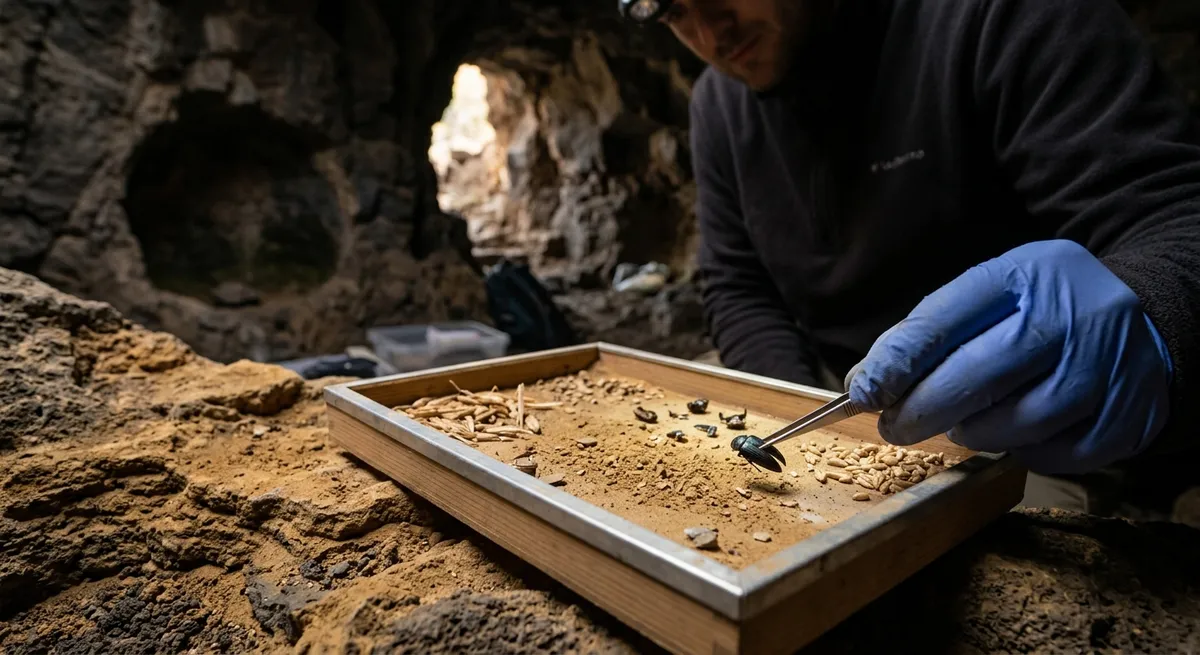
In a groundbreaking study, archaeologists have unlocked the secrets of Indigenous burial practices in the Canary Islands through the analysis of ancient insect remains. Over 8,000 preserved insects found in the Cruz de la Esquina cave in Gran Canaria reveal that this site was initially utilized as a grain storage area before transforming into a burial cave for the island's Indigenous peoples. These findings not only shed light on the region’s deep history but also challenge our understanding of pre-burial decomposition practices.
The Discovery: A Grain Storage Site Turned Burial Cave
The Cruz de la Esquina cave, once a practical granary, has long been suspected of playing a key role in the complex social and cultural practices of the Indigenous communities. Archaeologists became intrigued by the preserved insect remains, which provide a unique window into the daily life and burial customs of these early inhabitants. Analyzing the insect population within the cave allowed researchers to piece together the timeline of its use.
The analysis showed evidence suggesting that bodies were interred shortly after death, contradicting previous assumptions that decomposition processes would delay burials. This rapid transition from life to death rituals suggests a cultural significance surrounding funerary practices.
Understanding Archaeoentomology
So, what exactly can ancient insects tell us? This is where archaeoentomology, the study of insect remains in archaeological contexts, becomes invaluable. Insects, often overlooked in traditional archaeological digs, serve as silent witnesses, telling tales of ancient environments and human behavior.
In the case of the Cruz de la Esquina, the remains provided crucial information about the timing and context of burials. The types of insects identified indicate not just decomposition timelines but also the environmental conditions of the period. This makes insects a powerful tool for archaeologists aiming to reconstruct the intricacies of past societies.
Impact on Indigenous Canary Islands History
These findings contribute significantly to the broader narrative of Indigenous history in the Canary Islands, an area where much heritage was lost or disrupted following the Spanish conquest. Prior to this study, detailed accounts of Indigenous practices had become fragmented, making any new insights essential to understanding a culture deeply connected to its land and traditions.
The transition of Cruz de la Esquina from a granary to a ceremonial site exemplifies how ancient communities adapted their environments for both survival and cultural expression. By uncovering these practices, the study not only enhances the historical record but also pays respect to the cultural legacy of the Indigenous people of the Canary Islands.
Conclusion: Tiny Clues, Big History
The science of archaeoentomology demonstrates that sometimes the smallest clues can lead to significant revelations about our past. As researchers continue to delve into the insect remains at Cruz de la Esquina, they are not just unearthing facts about burial practices but also offering a narrative that brings to life the story of an entire culture. This research not only enriches our understanding but serves as a reminder of the complex tapestry that forms human history, often concealed in the most unexpected places. The insight gained from these insect remains challenges us to reconsider how we approach archaeological studies while emphasizing the importance of preserving Indigenous knowledge and history.