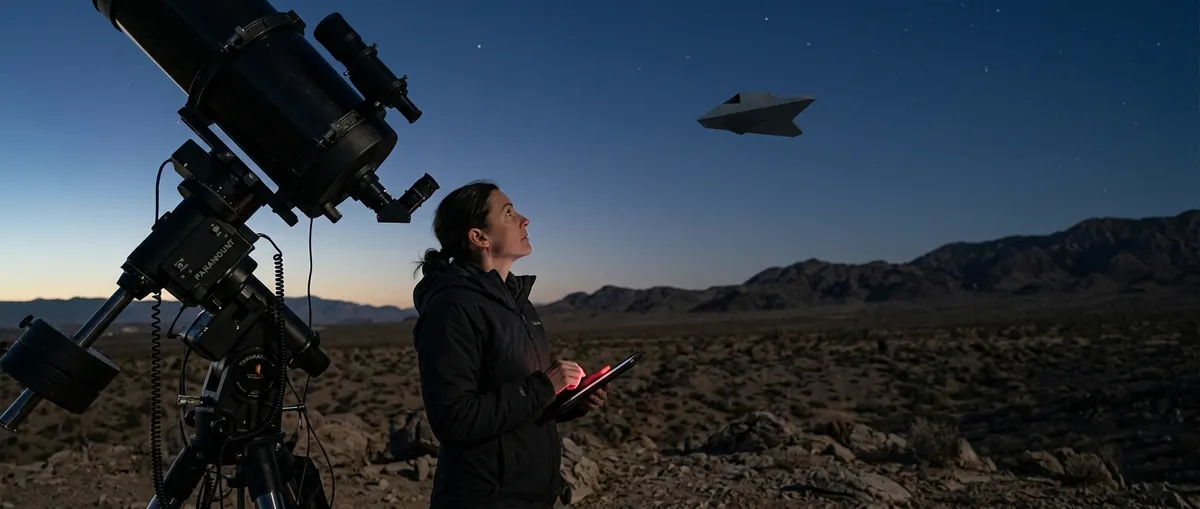
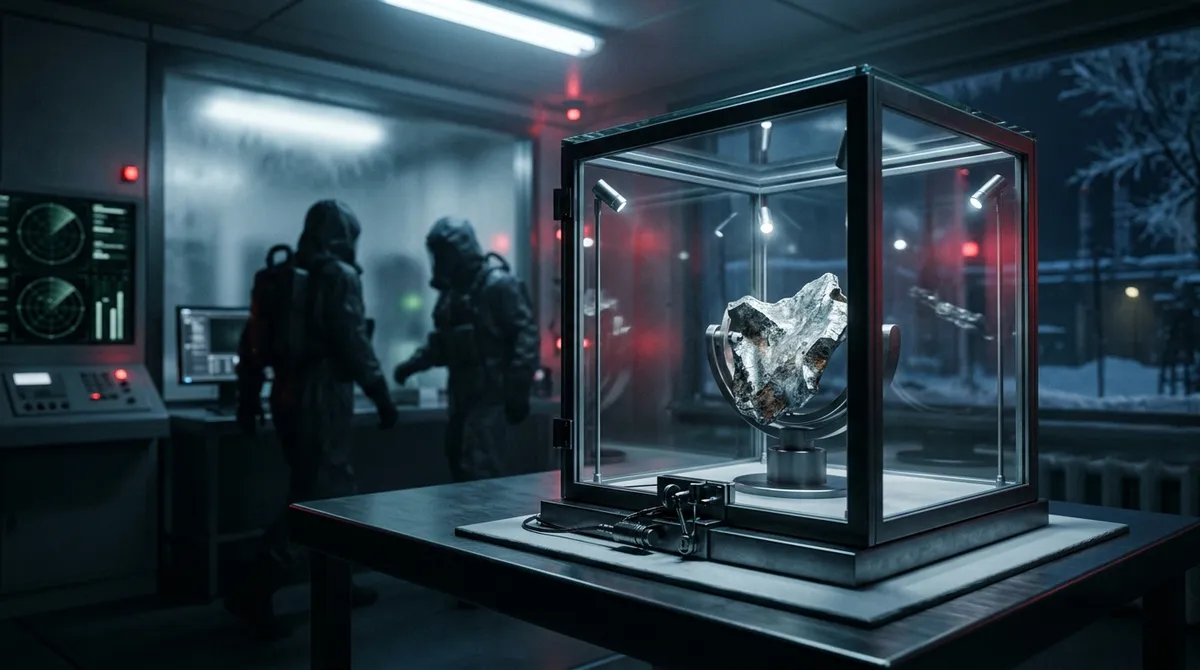
Ross Coulthart — the investigative journalist who has become one of the most closely watched voices in UAP reporting — is making a claim that deserves more than a headline glance: metals allegedly recovered by Russia from a UFO may have characteristics that science cannot explain as Earthly in origin. That is either one of the most significant statements in modern history, or it is exactly the kind of claim that collapses under scrutiny. By the end of this piece, you will understand which questions separate the two.
The Claim on the Table
As reported by NewsNation, Coulthart has stated that Russia recovered materials from what is described as an alleged UFO, and that those materials appear not to be from Earth. Coulthart has a track record in this space — he has been central to breaking UAP-related stories that later drew serious institutional attention — which is why his characterization carries more weight than a random online rumor.
The phrase "not from Earth" is doing enormous work in that sentence. It is worth pulling it apart.
What 'Not From Earth' Would Actually Require
For any material to be credibly classified as extraterrestrial, it has to clear a set of scientific bars that are demanding by design. Here is what legitimate analysis would need to establish:
Isotopic ratios outside any known terrestrial range
Every element on Earth carries a fingerprint — the ratio of its isotopes reflects the specific stellar and geological history of our planet. Meteorites already show us that material from elsewhere in the solar system carries measurably different isotopic signatures. A metal that is genuinely not from Earth should show isotopic ratios that fall outside every known terrestrial sample, every known meteorite class, and every known industrial alloy. That is a testable claim. It either passes or it does not.
Atomic structures or alloy compositions with no known manufacturing pathway
This is where the more extraordinary claims in UAP material research tend to land. If a metal contains elements layered or bonded in ways that no known industrial or natural process can produce — at temperatures and pressures available on Earth — that raises real questions. It does not automatically answer them, but it raises them.
Independent verification
One laboratory's finding, particularly one operating under government secrecy, means very little without replication. The history of science is littered with extraordinary results that evaporated the moment a second lab tried to reproduce them. For a claim of this magnitude, independent analysis by multiple institutions — ideally with published methodology — is the floor, not an optional extra.
None of this means the claim is false. It means the claim is currently unverifiable by the public, which is a different and important thing to say clearly.
Russia, UFOs, and the Secrecy Layer
The geopolitical dimension here is not decorative. Russia has its own long history of classified UAP research, some of which has surfaced through Soviet-era documents. If Russia recovered anomalous materials, the conditions under which any analysis occurred — the institutions involved, the chain of custody, the political incentives at play — would all affect how seriously independent researchers could treat the results.
Governments do not declassify things that give away strategic advantage. If Russia held materials with genuinely anomalous properties, the incentive to keep that classified would be overwhelming — not because of aliens, but because novel materials with unknown properties are a defense and aerospace asset. The secrecy itself is not evidence of extraterrestrial origin. It is entirely consistent with standard state behavior around any advanced or unexplained technology.
This does not make Coulthart's reporting wrong. It means the claim is trapped inside a box that governments on multiple sides have strong reasons to keep closed.
Why Coulthart's Role Matters
Coulthart is not a fringe blogger. He is an award-winning investigative journalist whose UAP-related work has helped shift the conversation from tabloid territory into congressional hearing rooms. When he reports something, there is typically a source — and typically a source with some proximity to official channels. That context does not make the claim verified, but it does mean dismissing it outright is intellectually lazy.
At the same time, Coulthart himself operates in a space where sources have strong incentives to leak selectively. Whistleblowers, intelligence community insiders, and defense contractors all have agendas — sometimes noble, sometimes not — and the reporter's job is to interrogate those agendas. Consumers of this reporting should hold the same standard: take the claim seriously, demand the evidence, and resist the pull toward both reflexive belief and reflexive dismissal.
The Larger Pattern This Fits Into
This report lands inside a broader and accelerating pattern. Public pressure for UAP transparency has pushed multiple governments toward at least performative disclosure. The U.S. has acknowledged recovered materials and anomalous craft in ways that would have been laughed out of a press conference a decade ago. The conversation has moved.
Claims about Russian-held materials extend the geography of that conversation in a significant way. If multiple governments independently recovered similar anomalous objects or materials, the implications compound quickly. It also raises the uncomfortable question of what those governments have been quietly communicating to each other — or not communicating — for decades.
What You Should Watch For Next
If this story has legs, here is what would constitute actual forward movement rather than noise:
- Independent scientists or institutions being given access to samples for analysis
- Published isotopic or structural data, even in partial form
- Coulthart or NewsNation providing additional sourcing detail beyond the initial report
- Any response — denial, confirmation, or deflection — from Russian official channels
Absence of those developments is not proof the claim is false. But their presence would be the difference between an allegation and evidence.
The metals either carry a signature that falls outside everything science has catalogued from this planet, or they do not. That is a question with a real answer. The fight worth having right now is over who gets to ask it — and who gets to see the results.